by TechGameReview |
in
Specs
at 6:08 AM
Visual Sound 1 Spot Combo pack
Originally named because it takes up just one electrical output spot, the 1 Spot offers a 9V DC output, with 1700mA of current available. It lacks multiple isolated outlets like the rest on test, but this useful wall wart
will power multiple pedals if you daisy chain them.Five-way and eight-way daisy chain connectors are available, as are plug adaptors – the system is probably best bought in the Combo pack version,which pairs the 1 Spot with a selection of cables.The 3m cable on the 1 Spot means you could keep it out of the way, next to your amp,minim ising stage cabling.
Verdict:
A simple, useful and cost effective piece of gear.
ORIGIN: China
TYPE: Universal 9V power adaptor
FEATURES: 1 outlet (1700mAtotal)
OUTLETS: 9VDC 2.1mm connector
SUPPLIED CABLING: Numerous
POWER: Mains, universal (115V–240V automatic sensing)
DIMENSIONS:48(w) x 50 (d) x 85mm (h)
T-Rex Fuel Tank Junior
The Junior is the smallest of the four units in the T-Rex Fuel Tank range, but we’ve chosen to spotlight it, as it seems the perfect no-nonsense choice for a small board of up to five pedals.You get five isolated 9V outputs, each capable of putting out 120 mA, so it will easily power a set of five standard pedals. In addition, you can use two of the outputs to power an 18V pedal via a serial cable (sold separately), or power five
pedals from one output (max 24 mA each)witha daisy chain cable (sold separately).
Verdict:
If you have high-current pedals,maybe look elsewhere, but if you use standard pedals this is an elegant choice.
ORIGIN: China
TYPE: Multiple-outlet power supply
FEATURES: 5 isolated outlets (600mA total)
OUTLETS: Numerous
SUPPLIED CABLING: 5 x 50cm with 2.1mm to 2.1mm connectors
POWER: Mains (proprietary figure-ofeight cable) switchable 115V or 230V
DIMENSIONS: 105 (w) x 78 (d) x 35mm (h)
Cioks DC10
Based in Denmark, Cioks has several power supplies inits own range, and also makes the Power Factor for Eventide. The DC 10 is the sort of supply that would be well suited to a medium-sized pedal board. It has no fewer than 10 outlets in eight isolated sections– outlets seven and eight share the same ground,as do nine and 10.We like the Swiss army knife approach of the DC 10, in that it seems to be designed to take on any pedal (including 15 V Radial Tone bones), and comes with all the cables you need–so it’s ready for action straight out of the box.
Verdict:
An extremely versatile power supply that will suit most pedal boards. If you have a massive ’board, check out the Ciokolate (£324).
ORIGIN: EU
TYPE: Multiple-outlet power supply
FEATURES: 10 outlets configured in 8 isolated sections (1600mAtotal)
OUTLETS: Numerous
SUPPLIED CABLING: Numerous
DIMENSIONS: 158(w) x 98 (d) x 35mm (h)
Pedaltrain Volto
The Volto will give you an uncluttered stage, because it’s a rechargeable unit that doesn’t require a mains power cable. What’s more, it’s not much bigger than some smartphones, so it’s easily portable. Powered
from a lithium-ion battery that can be recharged from a computer’s USB port or the supplied charger, the Volto has two 9 V outlets with a combined power capacity of 2000 mA, which can power as many pedals as they will support via daisy chain cables.How long the power lasts will depend on the number of pedals you’re connecting (36 hours for one to five;9 hours for 11-plus).
Verdict:
You won’t need to sort out mains power for the front of the stage, but you will have to remember to charge it.
ORIGIN: China
TYPE: Rechargeable pedal power supply
FEATURES: 2 outlets (2000mA total), 3-bar LED to show amount of charge, on/off switch
OUTLETS: 9VDC x2
SUPPLIED CABLING: Numerous
POWER: USB (supplied charger or 5V bus power), 6 hours recharge time from zero
DIMENSIONS: 120 (w) x 85 (d) x 18mm (h)
Voodoo Lab Pedal Power 2 Plus
Voodoo Lab was the first mainstream company to provide high-quality isolated power supplies for pedals, and the PedalPower 2 has become the go-to device. The latest version, the Pedal Power2Plus, has plenty of juice for a medium-sized pedal board, and some useful features not found elsewhere – such as a ‘sag’knob on two of the outlets, for turning down the juice to simulate alow battery–useful for transistor based fuzz circuits. There’s also an IEC output socket for adding another unit or a mains-powered pedal.
Verdict:
A solid choice, unless you have lots of high-current pedals. Ifso, try the Pedal Power 4x4.
ORIGIN: USA
TYPE: Multiple outlet power supply
FEATURES: 8 isolated outlets (1100 mAtotal)
OUTLETS: Numerous
POWER: Mains (IEC cable) 240V
DIMENSIONS: 152 (w) x 86 (d) x 44mm (h)
TheGigRig Generator
Known for pedals and switching,TheGigRig also offers its Modular Power Supply system,with the Power Path Diagram service, where it will design a system for your specific pedals.For a challenge,we put together an 11-pedal array,with some singular requirements (18V,Boss ACA, high-current, battery connector only, reverse polarity)–and the company built a complete solution.At its heart is the Generator,which supplies 5 amp sofpower–you then add Distributors, Isolators and Adaptors, and you can trim cables to length.
Verdict:
Costsmount as you expand, but this is a perfectly tailored and future-proofed option.
ORIGIN: UK
TYPE: Custommodular power supply
FEATURES: Multiple outlets (5000mA total)
POWER: Mains (IEC cable), universal (110V to 250V automatic sensing)
DIMENSIONS: 105 (w) x 60 (d) x 30mm (h)
by TechGameReview |
in
Specs
at 9:19 PM
Moog Minifooger Drive
The MFDrive employs a Moog Ladder Filter,FETamplifiers, and classicOTAs to create its dirt.You have a choice oftwo levels of range for the gain, to match the pedal’s input to what’s plugged into it.Again knob dials in the amount of dirt, delivering a wide range of sounds, from overdrivenamp through to fuzz tone, while an output knob offers enough extra clout to use the pedal as a booster. Theactual tone of the distortion is dialled in with interaction between the filter and tone knobs. There’s loads of bottom-end here – guitarists will not findmuchthat’s useful on the lower settings of the filter, but they’re just right for bolstering a bass.For guitar, there’s plenty of tonal variation, particularly in the upper mids and top, which can be accentuated with the peak switch, which adds a +15dB boost at the filter cut-off.
Verdict:
Anoverdrive distortion pedal with huge variability and a unique dirtywahif you ‘play’ the filter with an expression pedal.
ORIGIN: USA
TYPE: Distortion pedal
FEATURES:True bypass
CONTROLS: Gain, output, tone, filter, drive switch, peak switch
CONNECTIONS: Standard input, standard output, expression pedal socket
POWER: 9Vbattery or 9V DC adaptor
DIMENSIONS: 83 (W) x 144 (D) x58mm(H)
Moog Minifooger Trem
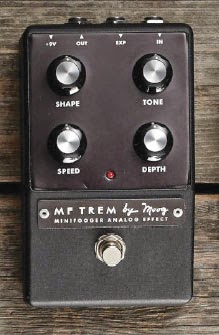
The MFTrem is no simple tremolo pedal. While most tremolos will let youdial in the effect you want with speed and depth knobs, those knobs are not so straight forward here there’s a lot of interaction between them and the othertwo knobs.The depth knob, for example, increases depth for most of its travel, but doubles the trem speed when at its max position. A shape knob alters thewaveform for amore lopsided throb, while the tone knob rolls back the treble content. The overall effect is that this pedal is capable of many more sounds than a standard tremolo pedal, or an amp’s built-in trem.You can get those classic optical tremolo sounds, but also harder ‘gated’ on/off percussive trem.The expression pedal is assigned to speed, so you can get rotary speaker-like ramps and, with the speed knob set to full, even ringmod-style effects.
Verdict:
If youare looking for a diverse range of tremolo sounds, this maybe for you.
ORIGIN: USA
TYPE:Tremolo pedal
FEATURES:True bypass
CONTROLS: Shape, tone, speed, depth
CONNECTIONS: Standard input, standard output, expression pedal socket
POWER: 9Vbattery or 9V DC adaptor
DIMENSIONS: 83 (w) x 144 (d) x58mm(h)
Moog Minifooger Boost
This pedal offerstwo boost paths. Youcan choose between up to 6dBof clean boost through aVCA (Voltage-Controlled Amplifier) signal path, or 12dB through a clipped OTA (Operational Transconductance Amplifier) path formore dirt.Anextra 6dBis available for both paths if you use an expression pedal. The VCA path offers quite a subtle boost, that won’t give a massive jumpin volume, but offers a nice tonal shift that enhances the sound and feel.The OTA path is nearer to a standard boost pedal, offering a touch of extra midrange and apparentcompression.Anexpression pedal can undertake various tasks, depending onwhere you set the gain knob: froma full-range volume pedal, throughswelling boost in and out in a musical fashion, or just hammering down for extra gain to drive your amp.
Verdict
Thoughtful rather than bombastic, with a nice tone knob. It cansweeten your signal chain and kick thingsupa gear.
ORIGIN: USA
TYPE: Boost pedal
FEATURES:True bypass
CONTROLS: Gain, level, tone, boost switch
CONNECTIONS: Standard input, standard output, expression pedal socket
POWER: 9Vbattery or 9V DC adaptor
DIMENSIONS: 83 (w) x 144 (d) x58mm(h)
Moog Minifooger Delay
Atrue analogue delay, like the MoogerfoogerMF-104 variants, theMFDelay features four BBD chips, allowing delay times of up to 700ms.Howdifferent manufacturers setupthe sound of the repeats varies greatly in this type of pedal, and Moog hascomeupwith repeats that are definitely analogue in theway they decay, but are not massively different fromthe dry sound; the result is a natural sound that blends smoothly in. We get delay time and feedback controls, a 100 per cent dry to 100 per centwetmixknob, plus a drive control with 22dBavailable forsomeboost or tonal colouring.You can connect an expression pedal assigned to control time or feedback, the former offering somestrange effects, the latter adding repeats as youneedthemor controlling the take-off into self-oscillation.
Verdict:
There aremany analogue delays, but the expression-pedal input and drive knob make theMFone of the most versatile.
ORIGIN: USA
TYPE: Analogue delay pedal
FEATURES:True bypass, 35ms-700ms delay time
CONTROLS: Time, feedback, drive, mix
CONNECTIONS: Standard input, standard output, expression pedal socket
POWER: 9Vbattery or 9V DC adaptor
DIMENSIONS: 83 (w) x 144 (d) x58mm(h)
Moog Minifooger Ring
Ring modulation, the ‘black sheep’ of the stompbox family, gets an airing here: theMFRing is based on theMoogerfoogerMF-102 (allegedly theworld’s best-selling ring-modpedal). Juxtaposition of the freq and tone knobs yields a wide range of buzzy, chiming and metallic tones that can be tuned to be musical with a certain scale, but dissonant on notes outside it. At the lowestmix-knob settings, you are getting subliminal ear candy— metallic resonance, for example—in the backgroundbehind your dry tone; but as youturn themixup, you gradually lose that dry sound to a full-on aural assault. What really appeals about theMFRing is the fact youcan use an expression pedal to control the freq parameter for sonic sweeps, or to switch betweentwo keys.
Verdict:
If you want to addsome(very) leftfield sounds to your rig, this is theway to go, butmake sure you buy an expression pedal with it if youreallywant to freak out with the freq.
ORIGIN: USA
TYPE: Ring modulator pedal
FEATURES:True bypass
CONTROLS:Tone, mix, frequency
CONNECTIONS: Standard input, standard output, expression pedal socket
POWER: 9Vbattery or 9V DC adaptor
DIMENSIONS: 83 (w) x 144 (d) x58mm(h)
Moog EP-3 Expression Pedal
Okay, it’s not a Minifooger, but the EP-3 is an essential add-on if you want to get the most out of any of these pedals, and apretty useful thing for any stompbox aficionado to own, as it’s a universal expression pedal that can be used with any musical equipment that supports the use of one. TheEP-3 comes with an attachedtwometre cable terminated in a jack plug that youplug into the expression pedal input on your pedal. Pressing downon the treadle sends a range of values from heel downto toe down– a knob on the side sets the control range so the pedal gives youeither the full range of parameter adjustment, or aproportion of it for, say, a tuned pitch change, or to switch betweentwo delay times.Mainly plastic, it’s robust enough for onstage use, and has a smooth treadle action.
Verdict:
Asolid choice for foot control of pedal parameters onstage and off – and the perfect, virtually essential, companion for any Minifooger.
ORIGIN: USA
TYPE: Expression pedal
FEATURES:Adjustable range of parameter control
CONTROLS:Output knob
CONNECTIONS: Lead with jack plug
POWER: None
DIMENSIONS: 90 (w) x 240 (d) x80mm(h)
by TechGameReview |
in
Specs
at 8:04 PM
Homebrew UFO
The UFO (UltimateFuzz Octave) is an octave fuzz pedal in the vintage style, but the octave effect has its ownfootswitch so youcan choose if you want to add it to the fuzz, which comes intwo flavours – vintage andmodern – selected with a toggle switch.Vintage is thick and creamy 60s-style fuzz, but with a nice rawedge, delivered via a tone knob that can dial insomethroaty upper-end presence to cut through the mix. Switched to modern, youinstantly get a fatter bottom-end andmore output, whichmakes the pedalmore willing to take off into harmonic feedback.The upper-octave effect is a real treat. It’smixed proportionally to be fairly prominent, but youcan tame it a touch with the tone knob if desired, and it works just fine all over the neck – no matter which pickup youare on – just flick it in to add extra interest to your solos and riffs.
Verdict:
Avery versatile fuzz box formodernand vintage sounds, that livesupto itsname.
ORIGIN: USA
TYPE: Octave fuzz pedal
FEATURES:True-bypass, octave footswitch
CONTROLS: Fuzz, level, tone, vintage/modern switch
CONNECTIONS: Standard input, standard output
POWER: 9Vbattery or 9V DC adaptor
DIMENSIONS: 125 (w) x 95 (d) x50mm(h)
Homebrew Detox EQ
The Detox, aPaul Gilbert signature pedal, has a party piece in that it can turn a distorted rock sound into a clean sound.Thekey is inusing the pedal’s level knob at a lowlevel – the effect is different fromsimply turning your guitar volume knob down(which canmake the sound a little muffled), as youhave the treble, bass andmidknobs to compensate for anyEQchanges. Without anyEQboosts, unity gain seems to be near the full travel of the level knob, so dialling it back will take the edge off a dirtampand really clean it upwhenyouare back to about 10 o’clock (Paul Gilbert’s preferred setting).The Detox isno one-trickpony, though; with the level knobup, those cut and boost tone controls can reallytweak youramp to your taste, adding a bit of sparkle, bottom-endwhompor whatever – especially useful if youhave anampwith minimal tone control.
Verdict:
Clever design offers practical tone tweaking with extra benefits.
ORIGIN: USA
TYPE: EQ pedal
FEATURES:True-bypass
CONTROLS:Treble, bass, mid, level
CONNECTIONS: Standard input, standard output
POWER: 9Vbattery or 9V DC adaptor
DIMENSIONS:70(w) x 120 (d) x 57mm(h)
Homebrew ParaDrive
The ParaDrive offerstwo related functions – overdrive and boost – independently in one box, each with its ownfootswitch.Theoverdrive is based on theHBEPower Screamer, itself derived fromaTube ScreamerstyleJRC4558Dcircuit, and has a three-way ‘diode select’ switch for tonal options, plus a ‘fat drive’ switch for extra low-end gain.Theboost section offers a gain increase, dialled in with a single knob.Oneposition of the diode switch offers classicTStone, although the ParaDrive hasmoreupits sleeve than a standardTube Screamer in terms of output level.Theothertwo offer variations withmore low-end, gain and dirt – useful choices to better match youramp.Theboost takes the overdrive to another level, but it’s great on its own – just kicking yourampupa notch.
Verdict:
Oneof the most versatile and practical overdrive pedalswe’ve seen lately. It’s like adding three extra channels, giving you four level/dirt options.
ORIGIN: USA
TYPE: Overdrive/boost pedal
FEATURES:True-bypass, independent boost and drive footswitches
CONTROLS: Gain, level, tone, boost,D.Sel switch, FD switch
CONNECTIONS: Standard input, standard output
POWER: 9Vbattery or 9V DC adaptor
DIMENSIONS: 125 (w) x 95 (d) x50mm(h)
Homebrew Germania
The Germania isHomebrew’s take on the classic Rangemaster treble booster fromthe 1960s, and offers upto20dBof gain to drive youramp. In its ‘hi-fi’ setting, you get a full range boost, but a ‘lo-fi’ setting offers amore focused boost in one of three frequency ranges controlled with the3Qswitch. Boost in hi-fimodeis bright, withsome germanium-driven grit to it, and as you turn the knob clockwise there’s a massiveamountavailable. In lo-fi mode, the three settings offer cut in the bottom but different midrange emphasis. This pedalworks best with an ampthat’s already overdriven, and especially one that’s dark-sounding – kick it in to take itupanother level and squeeze outsomeharmonics – it did a fine job with our oldnontop-boost AC30. It’s also great with a dirt pedal.
Verdict:
TheGermania can deliver a rawand aggressive boost, but that tonal shift won’t necessarily suit allampsettings, so try it out with your own.
ORIGIN: USA
TYPE:Treble boost pedal
FEATURES:True-bypass
CONTROLS: Gain, hi-fi/lo-fi switch,3Q switch
CONNECTIONS: Standard input, standard output
POWER: 9Vbattery or 9V DC adaptor (+9V rather than the more standard -9V needed)
DIMENSIONS:70(w) x 120 (d) x 57mm(h)
Homebrew CPR
HBE says that the CPR (ComPressorRetro) is modelled after a vintagecompressor circuit… but it’s not saying which one. Controls are fairly standard, with a sustain knob turningupthe compression and the level knob setting the appropriate output, with enough on tap for a neat boost function – with or without the sustain knob turnedup.The attack knob setshowquickly the compressor kicks in on your signal, allowing youto shape the front-end of your note envelope to suit the musical context – that Nashville snap being there if youwant it.We find the CPR does all the things you’dexpect froma good compressor – keeping the sound tight and focused, adding definition and helping squeeze out the sustain.
Verdict:
There are plenty of good pedal compressors, and the CPR joins the ranks; it might not appeal to those wanting to conserve space on their ’board, but it’ll certainly look good on it.
ORIGIN: USA
TYPE: Compressor pedal
FEATURES:True-bypass
CONTROLS: Sustain, level, attack
CONNECTIONS: Standard input, standard output
POWER: 9Vbattery or 9V DC adaptor
DIMENSIONS: 125 (w) x 95 (d) x50mm(h)
Homebrew Cremolo
With all-analogue FET-based circuitry, the Cremolo is designed to mimic vintage valve tremolos. Intensity and speed knobs are standardonany tremolo pedal, but the Cremolo also has a level knob that can not only compensate for any perceived volume dropwhenthe effect kicks in, but also has extra output to drive anampor match it to the chain. Two ranges of speed are available via a slow/fast switch, while another switch turns off the flashing speed indication LEDif youfind it irritating. There’s awarmth to the Cremolo that screams vintage, or rather whispers it softly into your ear – it’s a nicely rounded tremolo that really does sound as if itcamefrom a vintageamp.You get only one sound,
but it’s a good one with plenty of subtle shadings available via the intensity knob.
Verdict :
TheCremolo is all about vintage tone, ather than offering a range of tremolo types, so if you are looking for old-school amptremit might be just what youneed.
ORIGIN: USA
TYPE: Analogue tremolo pedal
FEATURES:True-bypass, flashing speed indication LED
CONTROLS: Intensity, level, speed, speed indication LED, off/on switch, slow/fast switch
CONNECTIONS: Standard input, standard output
POWER: 9Vbattery or 9V DC adaptor
DIMENSIONS: 125 (w) x 95 (d) x50mm(h)
by TechGameReview |
in
Review
at 3:16 AM
Undoubtedly one of the ‘hits’ of this year’s NAMM gear-fest, judging by the amount of social media interest it generated, this Gretsch Rancher is clearly designed to get you noticed. It might seem like a pretty daft idea, but perhaps surprisingly it involved a serious amount of hard work to get it right…
“It really did start with, ‘Hey, let’s put a Bigsby on an acoustic!’” says Gretsch’s Adam Bowden-Smith. “But what followed was about a year and a half of extensive R&D to get the guitar top correctly braced so it was strong enough to make the Bigsby usable without the whole thing collapsing!”
And that’s a good place to start, as the instrument is a pretty weighty, overbuilt proposition for an acoustic, even with the extra hardware. It’s all-laminate – unusual for a modern acoustic guitar at this price point – and the top has two chunky longitudinal braces, as well as some reinforcement plates under the bridge and the Bigsby.The back and top are also noticeably arched, again to add strength to the structure.
But it still looks cool.The striking triangular soundhole recalls the Rancher acoustics of the 1950s, designed to appeal to the country and western market.The shape of the guitar, with its steeply tapering sides, creates a shallow, but not thin line, depth and makes it a lot more endearing and comfortable than the concept suggests. It’s also cleanly built. The red finish coats only the top; the finish to the back, sides and neck – which has quite an attractive figure on our sample – is a rich ‘natural’mahogany colour. The polyester finish is quite thick, but that may help its plugged-in performance, if not its acoustic projection. There’s not a shortage of pickups for acoustic guitars, but Gretsch was having none of them. Instead, the firm developed the Fideli’Tronhumbucker specifically for this guitar (although due to the prolonged R&D time,Fender got to use it first on several more conventional guitars, including the Cabronita). “The ‘Fideli’ in the name gives the clue,” adds Adam.“We wanted the pickups to have clarity and a clear response, with minimal distortion (ie, low output), suited to acoustic guitars.They do necessitate using nickel or steel strings, of course.”
The placement of the pickup seems unusual, in that above the sound hole is, usually, the fingerboard.Not here.Gretsch curtailed the ’boardat the 16th fret so there was room for the pickup. But there ismethodin the madness.As part of the R&D,Gretsch developed an “isolation chamber in which the Fideli’Tronis encased. This separates the pickup from the rest of the guitar to minimise potential feedback issues.” This is o chamber seems to be a wooden box under the top, that encases the pickup.Are we alone in thinking this is one of the most unusual ‘acoustic’ guitars we’ve encountered?
Sounds
Hold on to your hats, it’s going to get weirder.The combination of the admittedly rather creaky Bigsby and the size able metal bar bridge certainly offends our acoustic purist sensibilities, but we can’t fault the mainstream neck shape, tidy vintage-style frets and very electric Gretsch like play ability. After string stretching, the Bigsby, for light shimmers at least, stayed in tune; and while the acoustic projection isn’t voluminous, there’s anold-school archtop or semi-like resonance that hints at its plugged-in performance. Played seated, it’s a little body heavy, but when strapped on via the two strap buttons it feels more comfortable.
Plugged straight into various ampsand our Line 6 Stage Source mini-PA, this is no pristine modern electro acoustic sound. It has more low-end than our jazz reference Epiphone archtop, not least due to the position of the humbucker, which is further away fromthe bridge than pretty much any archtop; but adding anLR BaggsVenue DI to our signal chain, and removing some low sand lower mids, and brightening up the high-end, we’re into more usable territory. Switching to a Peavey Delta Blues, with its on board tremolo and spacious reverb,we begin to get it.A big, dark single coil-y voice that is both atmospheric and textural–a great overdub guitar or apretty electric sounding ‘acoustic’ that’ll get you noticed in a good way.
Verdict
Many will see this as a publicity stunt by Gretsch, as opposed to a real musical innovation.And if we’re honest, although it initially brought a smile,we’d probably say there’s some truth in that. Is it really much different – appearance aside – fro many other Bigs bye quipped hollow body electric? It’s certainly less versatile. But while our head says no, our heart is drawnto not only the unusual concept but also its usable sound: it’s the sort of thing Daniel Lanois would use to create a soundscape.
It blurs the line between electric and electro-acoustic; and for the creative musician, that’s no bad thing: it’s a guitar that takes us somewhere we weren’t expecting.Whether you think it’s worth the asking price will depend on your musical and stylistic taste. But in the me-too modern guitar market, anything that dares to be different is welcome.
by TechGameReview |
in
Music
at 4:55 AM
The year 1968was one of great creativity, turmoil and change.TheTet Offensive sawpublic support for the Americanwar in Vietnam nosedive, Johnny Cash married June Carter,David Gilmour replaced SydBarrett in
Pink Floyd,TheBeatleswent to India,cameback again and recordedTheWhite Album, andJimiHendrix released Electric Ladyland.
Thoughadmittedly less earthshattering than all of the above, late 1967 through 1968 also saw a sea change in the thenCBSownedFendercompany’s amplifier line, with themuchloved‘ blackface’ models giving way to shinynew‘silverface’ designs. Changeswere initially cosmetic, but gradually the circuits evolved, too. Guitarists of a certain agemay roll their eyes, but there’sno denying that,muchlike Stratocasters andTeles with three-bolt necks, early ‘silverface’Fenders have seen their allure increase in recent years due in no small part
to the scarcity of, and skyrocketing price tags commandedby,more traditionally desirable vintage pieces fromearlier ‘blackface’, p ‘brownface’,blonde andtweed eras. It’s alsoworthnoting that whenTheBeatles performed live inpublic for the final time, on 30 January 1969, onthe roof on theirAppleHQat 3 Savile Row, their backline consisted entirely of ‘silverface’Fenders. As artist associations go, that’s not too shabby.
Late 2013 saw Fender revisit the ‘ silverface’ period for the first time when it announced the new’68 Custom Series: a Twin Reverb, Deluxe Reverb and PrincetonReverb that combine the spirit of an era with a few contemporary tweaks, rather than providing exacting recreations of the original models. All three amplifiers
feature silver and turquoise front panels, with narrow vertical black lines separating the control groups–detail that was swiftly phased out after early production runs – along with a ‘drip edge’ aluminium grille cloth trim (abandoned in mid-1969) and period-correct ‘tailed’Fender logo badge, whichwas dispensed with in 1973.
Viewed as a trio, these ’68 Customs are smart-looking amplifiers indeed.On the inside of each, you’ll find typical modernPCBbuild with a similar layout to the company’s corresponding ’65 ‘black face’ reissues, but there are noteworthy differences in the shape of Schumacher transformers, designed to replicate those used in the original class of ’68, and some other electronic tweaks.
Where originalTwins and DeluxeReverbs of the period would have had aNormal channel, sans tremolo or reverb, thenew’68s have aCustom channel with access to those global effects and anewvoicing, courtesy of a “modified Bassman tone stack” that’s billed as beingmore pedalfriendly. Where youwould have found aVibrato channel, there’s nowa ‘Vintage’ channel with amore traditional voicing. All threeamps, including the
single-channel Princeton, are designed to breakupa little earlier than their forebears, and feature reduced negative feedback, whichFender’s marketing blurb claims will offer a greater degree of touch-sensitivity.
Dueto currentEURoHS legislation,Fender is unable to ship amplifiers to theUKthat feature vintage-style opto-tremolo with a light-dependent resistor in the circuit – cadmiumsulphide being the offending material – so the company developed a solution for countries with this restriction in place. This involves the use of additional analogue components on a sub-PCBwithin the chassis, that do the job of the lamp/ photocell arrangement found insideUS versions of the amplifiers. Puristsmay justifiably be offended, but let’s not all rush out to blockade the ChannelTunnel in protest against EuropeanUnion bureaucracy. Despite online grumbles about the possibility of this introducingunwanted noise into the circuit or just generally beingABad Thing, it hasn’tprovided us with any sonic cause for concern during our time with the threeampson test, and the tremolo sounds are nothing short of lush.More on that shortly.
Fender used a variety of different speaker brands throughout the ‘silverface’ era, such as Oxford,JBLandUtah, but never Celestions, so it’s interesting that thecompany should opt to ‘go British’ – albeit via China – with the drivers in thenew’68 Customs. There’s a single CelestionG12V-70in the Deluxe, a pair in theTwin and aTen 30 in the smaller Princeton. It’s time to find out what all these modifications
meanfor the player…
Sounds
Onpoweringupand igniting those turquoise jewel power indicators – another departure fromvintage spec, as the originalswere red–we’re greeted with a level ofhum fromall three amplifiers that says, “Yes, I’m a valveampand you’ve switchedmeon” rather than boding ill; it’s certainly not intrusive. Plugging first into the
little Princeton,we’re immediately remindedhow loud and soulful a small 6V6-poweredcombocan sound, and also exactlywhy so many classic guitar tracks have been cut with theseampsover the years.
While youdon’thave to turn the volume controlmuchpast four before a guitar withPAFstylemedium-output humbuckers, or evena hotTele, starts to elicitsometasty raunch whenplayed hard. Believeus whenwe say that despite its 12-watt power rating and single 10-inch speaker, thisampcould be all youneed for gigging in these volume-limited times, as long as massive clean headroom isn’t a deal-breaker and your drummerisn’t ananimal. There’s certainlymore drive andcompression here than you’dget froma vintage ‘silverface’ Princeton, thanks to the circuit modifications, while the Celestion tightensupthe bottom-end, making for a less
muddybass response than that of the JensenC10R-loaded ‘blackface’ ’65 reissue. Regardless of the internal
shenanigans required tomake theampslegal on this side of the pond, the tremolo provides a warm, suitably retro throb, and the reverb is deliciously musical; with a good microphone in front of it, this compact amplifier sounds huge. Every studio should have one, and iftwangy vintage grit is your thing, so should you.
Over to the Deluxe, then, and predictably, there’s a noticeable jumpin output and headroom. Oneof the all-time classic gigging and recordingamps, in thisnewincarnation the Deluxe Reverb is arguablymore practical than ever, thanks to the extra versatility offered by being able to utilise the tremolo and reverb on both channels. It negates the temptation to snip the bright cap on theVibrato channel, as somanyhave on both the reissue and vintage models over the years in order to get theampto play ball with overdrive pedals.
Compared to the ’65 reissue’s Vibrato channel, the ’68 model here has a little less brightness and headroomon theVintage side, but there’s still a magic sweet spot between4.5 and 6 on the volume control (depending on your choice of guitar),where theampdelivers awonderful, dynamic dirty-clean rhythm sound at stage level thatworks as a brilliant core guitar sound for allmannerof rock ’n’ roll, Americana, blues and classic pop applications. Just add picking-hand dynamics and your guitar’s volume control; there’s somuchrange here.
The Customchannel has considerablymore grit than a vintage DeluxeReverb’s Normal channel, andsome
Tweed-like character, too.Fully maxed – if your ears/spouse/ neighbour/sound engineer permit – there’s a real, grininducingNeilYoung vibe: it’s flabby,compressed and ugly in a thoroughly pleasingway. Again, the onboardreverb and tremolo arewonderful, classicsounding musical tools that push and inspire you to play in
a certainway.Farmore than ameansofmerely amplifying your guitar sound, this is a musical instrument in itself.
Compressed and flabby certainly aren’t adjectives that most playerswould apply to a vintageTwinReverb, and the ’68Customdoes little to dent theTwin’s reputation as a simply colossal-sounding amplifier. Thanks to a solidstate rectifier, a pair of 12-inch drivers and a quartet of 6L6s, there’s headroomto spare and a piano-like bass response, along with a three-dimensional high-end.Youcan drive this thing by cranking itup, of course, but in 2014we can’t think of a live venue that will let youget away with it!
Many players will find the Twin too impractical for everyday use, but if youget all of your drive tones frompedals and crave headroom, or if you are a post-rock player looking for arctic sheets of clean tone
on which to build heavily effected soundscapes, then it’s an excellent choice.
Verdict
While the list prices of all three ’68 Custom amps find them sailing dangerously close to waters occupied by serious boutique competition, both online and on the street it’s a happier tale, with the Princeton readily available for around£750, the Deluxe £910 and theTwin £1,130 frommajor retailers at the time of writing.
In use, theTwin Reverb is every inch a classic, but most players will find that the DeluxeReverb, or eventhe
Princeton, ismore than enough amplifier for their needs. Master volumes?Effects loops? Whenthe playing experience is this musical and immersive, whoneeds ’em?